Why 'pets welcome' doesn't tell AI anything
By Wendy Harris·13 November 2026·5 minute read
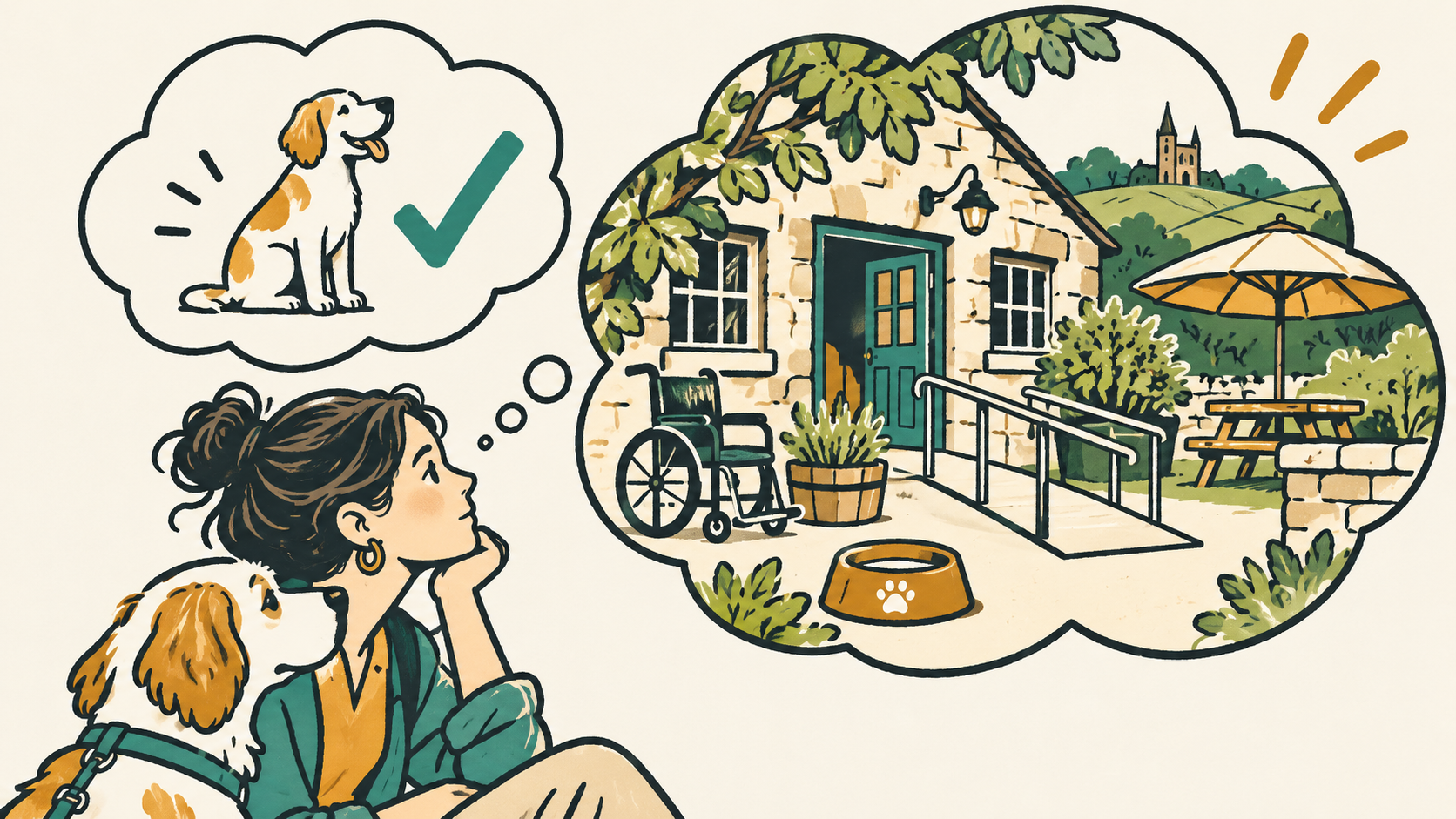
Someone planning a trip with their dog asks an AI assistant whether a cottage takes pets. Someone who uses a wheelchair asks whether a hotel has step-free access to the room. Both are specific, answerable questions, and both are the kind an AI system now gets asked on a visitor's behalf rather than left for the visitor to work out themselves by reading a page.
The trouble is what most websites actually say. "Pets welcome" on a general information page. "We welcome guests of all abilities" somewhere near the contact details. Both are true, friendly, and useless to anything trying to match a specific need to a specific room, because neither says which rooms, which areas, or what "welcome" actually means in practice.
What glassmark's own scans show
glassmark checks for exactly this, and the pattern is consistent enough to be worth a plain description rather than a guess. Looking at accommodation sites scanned since these two checks were added (holiday cottages, campsites, hotels and bed and breakfasts; the checks are not run on other business types, so attractions and places to eat are not part of this count), 50 sites have been scored against each so far.
On accessibility detail, 32 of those 50 had no accessibility information findable on the site at all. A further 3 had something, but too general to say anything useful about a specific room or route. Only 15 had the kind of detail an AI system, or a person, could actually act on: step-free access from the car park, a ground-floor room available, a bathroom with grab rails.
On pet policy, the pattern is similar and slightly worse: 42 of 50 had no findable pet policy whatsoever. 4 had a policy stated once, at the level of the whole business, which is a problem for anywhere with more than one unit, because "pets welcome" at the top of the site does not say which specific cottage, room or pitch that applies to. Only 4 stated it clearly enough, and at the right level, to be useful.
Neither number is a verdict on the businesses concerned. Most of this information already exists somewhere, usually in an email reply to the guest who asked, or in a conversation at check-in. It has just never been written down on the page in a form anything other than a human reading closely would notice.
Why "welcome" isn't the useful word
A generic reassurance answers a different question from the one actually being asked. "Pets welcome" tells a reader that pets are, broadly, not a problem. It does not tell an AI system which of your rooms, cottages or pitches that applies to, whether there's a size or breed limit, or whether there's an extra charge. Without that, the honest response from an AI system reading your site is no answer at all, or a guess, neither of which gets you the booking.
The same goes for accessibility. "Accessible facilities available" is a sentence with no information in it that a system (or a person planning around a specific need) can actually use. Step-free from where to where? Is the accessible route to the room the same as the one to reception? Is there a hearing loop at check-in? Each of those is a different, answerable fact, and each is usually knowable to the person who runs the business without needing to ask anyone.
What a specific answer actually looks like
The fix is not a new system or a redesign. It is writing the same information down with the specific case named rather than smoothed over.
Instead of "pets welcome", something like: "dogs are welcome in our garden cottages and the courtyard rooms. The main house and the orchard suite are pet-free. No additional charge for one dog per booking."
Instead of "accessible facilities available": "step-free access from the car park to reception and to the ground-floor Willow room, which has a walk-in shower with a seat and grab rails. The upstairs rooms are reached by stairs only."
Neither example needs new information gathered from scratch. Both are things the business almost certainly already knows and has probably already said, once, to a guest who asked directly. The work is writing it down once, specifically, on the page itself, rather than leaving it to be found out by asking.
If there's more than one room, cottage or pitch, the detail needs attaching to the specific unit it describes, not stated once for the whole site and left for a reader to guess whether it covers everything. That per-unit attachment is exactly what the partial scores above are catching: a true statement, made at the wrong level of detail to be useful.
How to check your own site
Read your own site the way the question would actually be asked. Could you answer "which of your rooms take a dog" or "which room has step-free access to an accessible bathroom" using only what's written on the page, without needing to already know the business? If the honest answer is "you'd have to ask", that's the gap.
A free glassmark scan will say the same thing back plainly, specific to your own site, without needing you to work it out by eye.
Worth doing even without a promised result
As with every change in this category, nobody can promise a specific result from writing this down, and it would not be honest to claim one. What can be said plainly is that it costs an afternoon at most, needs no developer and no redesign, and it removes a real gap between what you actually know about your own rooms and what's written down anywhere a visitor, or something answering on their behalf, can find it.
Read more
- The structured data that actually matters now
- What we found in 39 visitor economy websites
- The AI visibility check your website builder just added
What does AI find when it reads your website? Free scan at glassmark.ai, no developer required.
Run your free scan