What we found in 39 visitor economy websites
By Wendy Harris·3 November 2026·5 minute read
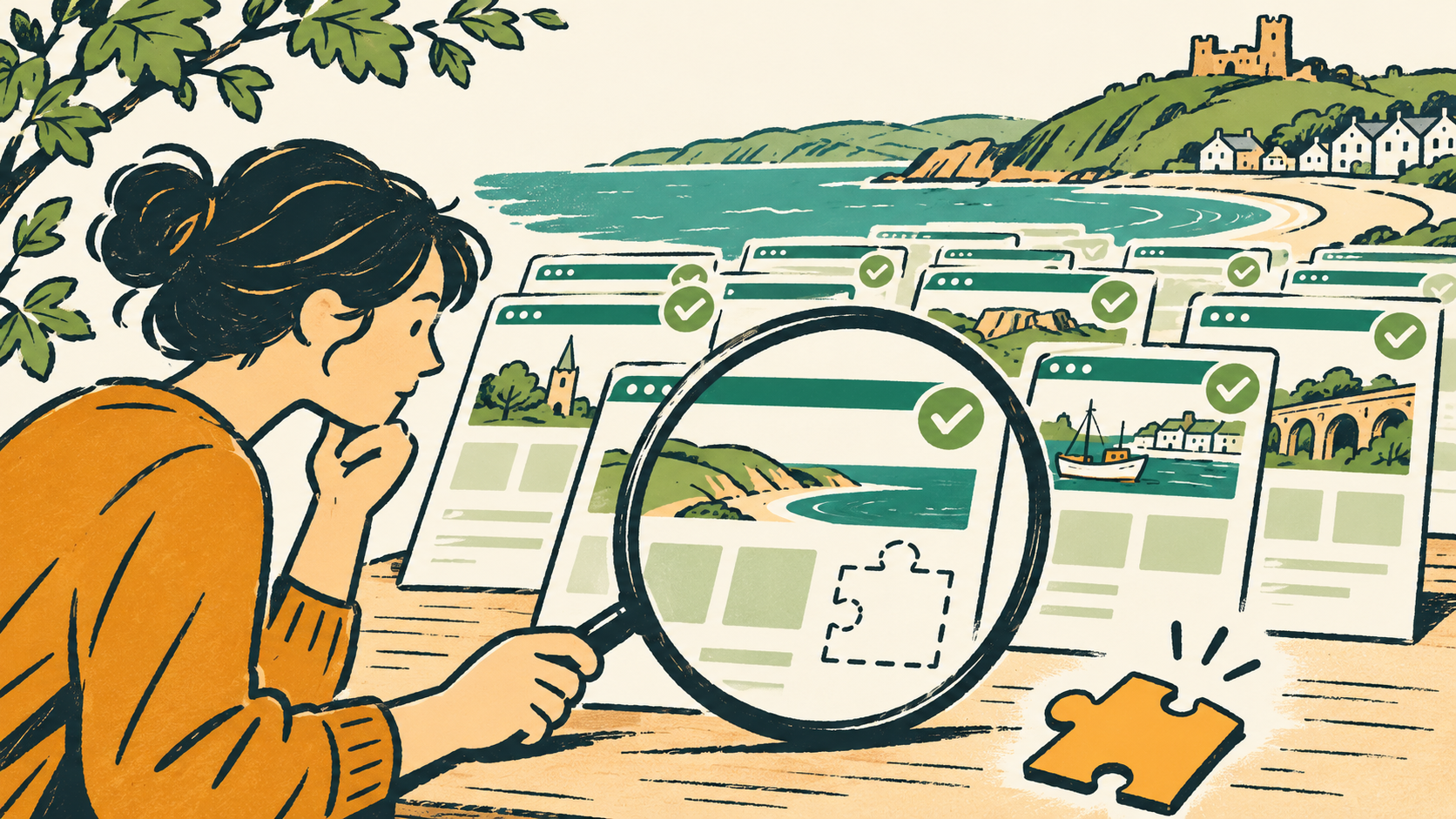
Between April and August this year, 39 visitor economy websites were scanned with glassmark. Holiday cottages, campsites and glamping sites. Pubs, inns and restaurants. Boat trips, a surf school, a cycle hire business. Gardens, a museum, a theatre, a wildlife attraction. Most of them in the South West of England, and most of them small.
The short version is not the one most people expect. Very little was broken. Almost everything was missing.
The plumbing was mostly fine
The fear operators usually arrive with is that something is blocking AI from reading the site at all. In this sample, that was mostly not the problem.
Of the 39 sites, 27 had a robots.txt file that existed and allowed AI crawlers, and 26 had a working sitemap. Thirty served their main content without needing JavaScript to run first, which matters because AI crawlers generally do not wait for content that loads late. Of the 29 sites with an online booking widget, all 29 had it in a form a crawler could reach.
Five sites were blocking crawlers through robots.txt: four blocking everything, one blocking certain AI crawlers specifically. Seven more had no robots.txt file at all, which is untidy but is not the same as blocking. So the accidental blocking problem was real on five sites out of 39, rather than the epidemic the category tends to imply.
The doors, in other words, were open. There was just not much inside for a machine to read.
What was missing was the answers
Here the numbers stop being reassuring.
Not one of the 39 sites had its opening hours in structured data. Not one had a review rating in structured data, and not one had individual reviews marked up. Not one described where it sits in relation to the place around it, the property that tells a machine this cottage is in that valley, in that National Landscape, near that town.
Thirty-eight of the 39 had no FAQ structured data. Thirty-four had no geographic coordinates. Thirty had nothing identifying what kind of business they are, with nine more getting it partly right. Twenty-nine gave no structured directions for getting there.
The phrase doing the work in every one of those sentences is "in structured data". It does not mean the information is absent from the website. On most of these sites the opening hours were right there on the page, in words, perfectly clear to a person. The reviews were there too, often as lovely quotes on the homepage. What was missing was the machine-readable version: the same facts, in the standard format a system can lift without guessing.
That distinction is the whole finding. These were not bad websites. Several were beautiful. They were written entirely for people, at a moment when a second kind of reader started to matter.
Why the pattern looks like this
It is not negligence, and it is not a skills gap in the sector.
Website platforms and themes ship the plumbing. A sitemap, a robots.txt, a booking widget that works: those arrive with the platform, which is exactly why they were the parts that scored well. Structured data about your particular business does not arrive with the platform, because the platform does not know your opening hours, whether you take dogs in the shoulder season, or which stretch of coast you look out over. Somebody has to put those in deliberately, and on a small site nobody was ever asked to.
So the gap is not evenly distributed by effort. It is distributed by what came in the box.
Why this matters more this year than last
Because the way people use these systems has settled into a shape that puts the weight on your own words.
In IMG's 2026 travel outlook survey of more than 1,000 respondents, 33% said they were likely to use AI tools to help plan travel this year. Among those, 75% expected to use it for recommendations and 13% for booking. Recommendation is where the volume is. Booking, for now, is not.
That split is good news for a small operator, and it is the reason the missing structured data costs something. If an AI system is mostly recommending rather than transacting, then the decision it makes is a decision about information: whose facts are clear enough to repeat. When your hours, your location, your reviews and your policies are not in a form it can lift, it does what it always does with a gap. It answers anyway, from somewhere else.
The ten-minute check
You do not need a developer for the first look, and you do not need glassmark either.
Open Google's Rich Results Test, paste in your homepage address, and run it. It will show you the structured data on that page, which is roughly what a machine can read without interpretation. Then ask one question of the result: are my opening hours in there, is my location in there, is what kind of business I am in there?
If the answer is no to all three, you are where 30 of these 39 sites were. That is a normal place to be, and it is a short job for whoever looks after your website. Send them the result and ask for business schema on the homepage with hours, location and business type in it. That single request closes most of the gap this scan found.
Method, and what this does not prove
Thirty-nine websites, the first scan of each, between 11 April and 24 August 2026. Each scan read the main pages rather than the whole site, 117 pages in total, an average of three per site. Findings therefore describe those pages, not every page.
These sites came to glassmark rather than being chosen at random, so the sample is self-selected and probably leans towards operators who already had the question on their mind. If anything, that makes the results flattering rather than harsh. Businesses outside the visitor economy, glassmark's own sites and test scans were all excluded. A few checks apply only to certain kinds of business, so some counts are out of 22, 28 or 29 rather than 39.
Thirty-eight of the 39 landed in glassmark's lowest band. The average score was 26 out of 100 and the highest was 42. That is not a sector doing badly at something it was trying to do. It is a sector that has not been asked yet.
Read more
- Google's Rich Results Test
- schema.org LocalBusiness, the vocabulary these checks look for
- IMG 2026 travel outlook survey, on how travellers expect to use AI
- When your website says nothing, AI fills the silence
What does AI find when it reads your website? Free scan at glassmark.ai, no developer required.
Run your free scan